
Robotics is entering a period in which the most important question is no longer whether a machine can repeat a programmed motion. Industrial robots have done that with extraordinary speed and precision for decades. The question now is whether a machine can perceive an uncertain environment, decide what matters, make physical contact, adapt when reality differs from its model, and fail without causing unacceptable harm.
This is the frontier of embodied intelligence: intelligence expressed through a body acting in the physical world.
The phrase is sometimes used as if a language model placed inside a humanoid shell automatically becomes a general-purpose robot. It does not. Language can help a system interpret instructions, decompose tasks, or connect visual observations to concepts. But a robot must also estimate geometry, forces, friction, balance, timing, material properties and the consequences of contact. A plausible sentence can be revised in milliseconds. A poorly controlled movement may break an object, damage equipment or injure a person.
That difference is fundamental. Robotics is not merely artificial intelligence with motors. It is the science and engineering of closing a continuous loop between perception, reasoning and action under physical constraints.
From automation to embodied intelligence
Traditional automation works best when uncertainty has been engineered out of the environment. A factory robot may weld the same points on the same vehicle body inside a guarded cell. Its value comes from repeatability. The machine does not need a broad understanding of cars, welding or human intention; it needs a reliable trajectory, calibrated equipment and a controlled workspace.
Embodied intelligence addresses the opposite problem. The environment may change, objects may be placed differently, people may move nearby, and the task may require several dependent actions. The robot must repeatedly answer four questions:
- What is happening around me?
- What physical state am I in?
- Which action best advances the task?
- Did that action have the intended effect?
The fourth question is particularly important. A capable robot cannot simply execute a plan; it must detect error and recover. A cup may slip. A door may resist. A surgical tool may approach tissue from an unsafe angle. An apparently minor deviation can propagate through a long task until success becomes impossible.
Embodiment therefore includes the entire system: sensors, actuators, mechanical design, control software, learned policies, energy supply and the environment in which the robot operates. Intelligence does not reside in one model alone. A compliant hand can simplify grasping by adapting mechanically to an object's shape. Tactile sensing can reveal a slip that a camera cannot see. A carefully designed workplace can make navigation safer. Sometimes the best improvement in intelligence comes from better hardware or better task design rather than a larger neural network.
Why impressive demonstrations can mislead
Robotics videos often compress a difficult research result into a few flawless seconds. They rarely show how many attempts were required, whether the scene was carefully prepared, whether a human intervened, or how the system behaves after a small disturbance. A demonstration can be scientifically meaningful and still provide little evidence of commercial reliability.
Several distinctions matter:
- A single successful run is not a success rate. Reliability requires repeated testing across meaningful variations.
- A short task is not a long-horizon task. Even a robot that succeeds in each step 99 percent of the time has only about a 90 percent chance of completing ten independent steps without failure.
- Remote operation is not autonomy. Teleoperation may be useful and economically valuable, but a human remains inside the control loop.
- Laboratory variation is not open-world variation. Changing the position of familiar objects is different from encountering unfamiliar objects, lighting, surfaces, people and hazards.
- Task completion is not safe task completion. Speed and success must be evaluated alongside force, collision, stability, recovery and near misses.
This is why robotics needs measurement science as much as it needs spectacular machines. Benchmarks should expose failure conditions, not merely reward average performance. They should describe the operating domain: the surfaces, lighting, objects, payloads, human proximity and disturbances under which a result is expected to hold.
The United States National Institute of Standards and Technology develops test methods and performance metrics for robot perception, grasping, mobility, manipulation and human–robot interaction. This work is less visible than a humanoid demonstration, but it is essential. Without reproducible measurements, buyers cannot compare systems, regulators cannot reason about risk, and researchers may optimize for demonstrations instead of dependable capability.
The appeal—and cost—of the humanoid form
Humanoid robots attract attention for a practical reason: much of the world was built around the human body. Doors, stairs, shelves, tools, vehicles and workstations assume our approximate height, reach and dexterity. A machine that can operate in those spaces could use existing infrastructure instead of requiring every environment to be rebuilt.
Yet the humanoid form also imposes severe engineering costs. Two-legged balance is more difficult than wheeled mobility. Arms with many joints require control, calibration and maintenance. Human hands combine strength, sensitivity and dexterity in a compact structure that remains extremely difficult to reproduce. Battery mass competes with operating time and payload. Falls are dangerous to the machine and to nearby people.
For many jobs, a humanoid is not the best answer. A wheeled mobile manipulator may be more stable and energy-efficient. A fixed arm may be faster and more precise. A soft wearable device may assist a person's movement without replacing the person. Robotics should be judged by fitness for purpose, not resemblance to human anatomy.
The likely future is therefore plural. Humanoids may become useful where human-compatible geometry matters, but specialized robots will remain dominant wherever specialization improves safety, cost or reliability.
Learning across robots: the promise of generalist policies
Modern robot learning is attempting to move beyond one controller for one task. Vision-language-action systems connect images and language instructions to robot actions. In principle, a shared model trained on many tasks and machines could transfer knowledge: learning that a handle affords pulling, for example, rather than memorizing a trajectory for one particular drawer.
The Open X-Embodiment collaboration assembled data from 22 robot embodiments across 21 institutions, covering hundreds of skills and more than 160,000 task descriptions. Its RT-X experiments offered evidence that cross-robot data can improve transfer and generalization. The significance is not that a universal robot already exists; it is that robotics may benefit from diverse shared datasets in a way analogous to large-scale pretraining in language and vision.
The analogy has limits. Internet text is abundant and inexpensive to copy. High-quality robot experience is slow, costly and hardware-specific. Every trajectory depends on camera placement, gripper geometry, control frequency and physical dynamics. Failed actions may damage equipment. Data from a simulation can help, but the mismatch between simulated and real friction, deformation, lighting and sensor noise—the sim-to-real gap—remains consequential.
Generalist models also inherit the problem of distribution shift. A policy trained on common kitchens may fail in a cluttered care home. A command such as “clean the spill” contains hidden decisions about which liquid is safe to touch, which objects must be moved and when a human should be asked for help. Language understanding can organize a task, but it does not certify the safety of the resulting motion.
The strongest near-term systems are therefore likely to combine learned components with conventional control, explicit constraints and human supervision. Neural models can propose goals or interpret perception; planners can check reachability; low-level controllers can enforce force and stability limits; monitoring systems can stop execution when confidence or sensor agreement deteriorates.
Contact is the real world’s examination
A robot can appear intelligent while moving through empty space. Contact reveals whether it understands the physical world.
Locomotion and manipulation both involve discontinuities: a foot strikes the ground, a gripper closes on an object, or a tool begins to cut. Small modelling errors can produce large changes in force. Recent research on Koopman-based global linearization has shown a way to represent contact-rich dynamics for elaborate locomotion and manipulation control. Such work matters because robust contact cannot depend solely on predicting a perfect trajectory in advance; the controller must respond quickly as contact conditions change.
Legged robots already demonstrate impressive running, jumping and recovery in research settings. But deployment requires more than athletic capability. A useful machine must repeat ordinary actions for hours, tolerate dust and wear, manage heat and energy, recognize when it needs maintenance, and remain predictable around people. Reliability engineering may contribute more to adoption than another acrobatic manoeuvre.
Manipulation presents a parallel challenge. Cameras reveal shape and position, but they cannot directly measure whether an object is slipping inside the hand or how much pressure is being applied to a fragile surface. Human manipulation depends deeply on touch. We adjust grip force before consciously noticing that an object has moved.
Touch changes what a robot can know
Tactile sensing is one of the clearest advances at the current frontier. A 2026 study in npj Robotics introduced a tactile-reactive gripper with an active palm, compliant fingers and vision-based tactile sensing. The design was evaluated on benchmark objects, fruit-picking scenarios and industrial tasks. Its importance lies not in claiming human-level dexterity, but in showing how palm contact and local tactile feedback can expand the range of stable grasps.
Another 2026 study introduced SuperTac, a biomimetic multimodal tactile sensor able to detect several forms of information, including force, contact position, temperature, proximity and vibration. The researchers paired it with a tactile-language model for perception tasks. Multimodal touch can help distinguish interactions that look similar to a camera but feel different to a body.
Researchers have also developed a whole-arm sensorimotor system with tactile skin, allowing contact along the arm—not only at the fingertips—to contribute to adaptive manipulation. This reflects an important lesson from biology: the body is not merely a platform carrying sensors. Its surfaces and compliance participate in perception and control.
However, tactile research still faces difficult questions. Sensors must survive repeated impacts and abrasion. Signals drift with temperature and wear. Covering a large robot body produces enormous streams of data. Calibration must remain stable, and feedback must arrive quickly enough to prevent damage. Laboratory prototypes demonstrate mechanisms; products must demonstrate lifetime, manufacturability and maintainability.
Medicine: assistance, autonomy and the space between them
Medical robotics illustrates both the potential of embodied intelligence and the danger of imprecise language.
Systems commonly described as “surgical robots” are generally computer-assisted instruments controlled by a surgeon. The US Food and Drug Administration explicitly notes that robotically assisted surgical devices do not perform surgery without direct human control. They can offer enhanced visualization, smaller incisions and precise instrument movement, but the surgeon remains responsible for the procedure.
Research is gradually exploring higher levels of autonomy. In 2025, the SRT-H framework used hierarchical, language-conditioned imitation learning to perform the clipping-and-cutting stage of a cholecystectomy on eight ex vivo porcine gallbladders. The system completed the tested cases autonomously and recovered from some suboptimal states. This was a notable result in long-horizon soft-tissue manipulation.
It was not autonomous surgery on living human patients. The tissue was outside a living body; the sample size was eight; and the experiment did not reproduce breathing, bleeding, unexpected patient movement or the full range of clinical complications. The correct conclusion is that step-level surgical autonomy has advanced in a controlled ex vivo setting—not that surgeons are about to be replaced.
Another path is the surgical copilot. A 2026 vision-language system for robot-assisted prostatectomy was trained on a large collection of question-and-answer examples and deployed to provide contextual guidance during an operation. Such systems may assist with phase recognition, anatomical orientation, documentation or warnings. Yet guidance must be validated prospectively: a fluent but incorrect recommendation in surgery carries a very different risk from an inaccurate answer in ordinary conversation.
Clinical progress will depend on evidence that a system improves outcomes, not merely that it completes a technical task. Trials must consider patient selection, training, oversight, failure recovery, cybersecurity and responsibility when human and machine decisions interact.
Restoring capability rather than replacing people
Some of robotics’ most humanly significant applications are assistive rather than autonomous.
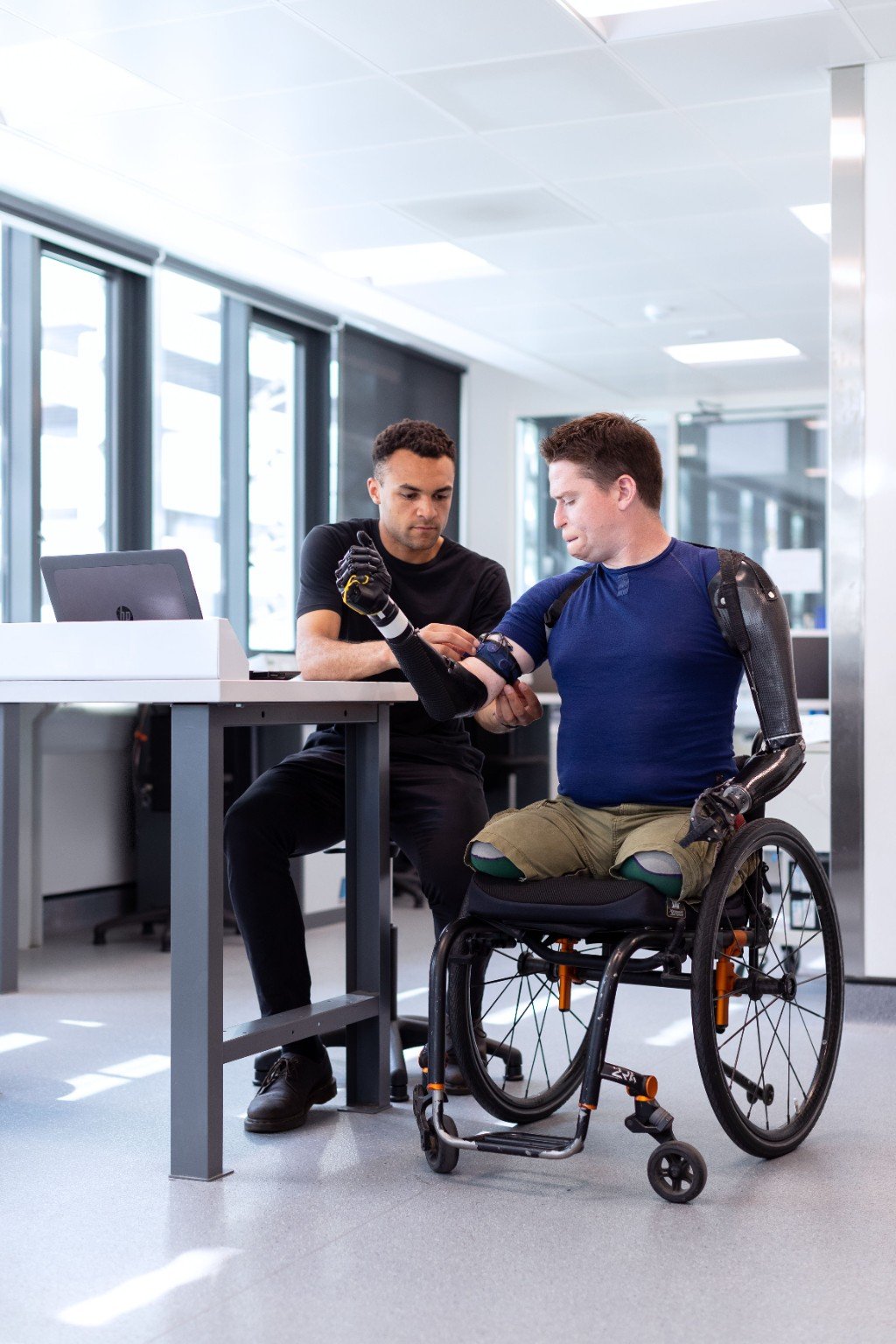
A 2026 Nature Communications study described a soft neuroprosthetic hand with 11 degrees of freedom and evaluated it with four people with amputations during daily activities. Another study in Nature Machine Intelligence reported a soft hand exoskeleton designed to restore intentional grasping for people with severe hand impairment. These systems combine compliant mechanics, sensing and user intention to extend a person's agency.
The early results should be interpreted with both hope and discipline. Small participant groups can demonstrate feasibility, comfort or task performance; they cannot establish how a device will perform across diverse bodies, conditions and years of daily use. Real adoption depends on weight, fitting, battery life, cleaning, repair, training, reimbursement and whether users actually choose to wear the device outside a laboratory.
The ethical objective also matters. A successful assistive robot should not force the user to adapt to the preferences of an engineering benchmark. It should respect the person's goals, privacy, dignity and control. Restoration of agency is a more meaningful measure than technical novelty.
Bounded autonomy will arrive before general autonomy
The most credible path to wider deployment is bounded autonomy: a robot performs defined tasks within a specified environment, while humans set goals, supervise exceptions or take control when limits are reached.
This already appears in warehouses, laboratories, agriculture, inspection and planetary exploration. The boundaries may be geographical, procedural or behavioural. A robot might navigate only mapped corridors, handle a known family of containers, or stop when perception confidence falls below a threshold.
Boundaries are not evidence of failure. They are an engineering method for converting an open-ended problem into one that can be tested. Aircraft autopilots, medical devices and industrial control systems all depend on defined operating conditions. The responsible question is not “Is the robot autonomous?” but “Which decisions can it make, under what conditions, with what evidence of safety, and who handles the exceptions?”
This vocabulary also prevents autonomy from being treated as a single ladder leading inevitably to human equivalence. A robot may be highly autonomous in navigation but dependent on a human for task planning. It may manipulate familiar objects independently but request assistance for an unfamiliar package. Different capabilities mature at different rates.
Safety is a system property
Robot safety cannot be added at the end as an emergency stop button. It must be designed into mechanics, sensing, software, human procedures and organizational responsibility.
Several risks interact:
- Physical risk: collision, crushing, cutting, burns, falls or unintended forces.
- Perception risk: objects or people are missed, misclassified or poorly localized.
- Decision risk: the system chooses an unsafe action despite accurate sensing.
- Cybersecurity risk: communications, software updates or remote-control channels are compromised.
- Human-factors risk: an operator misunderstands the robot’s state, trusts it too much or cannot intervene in time.
- Organizational risk: responsibility is divided among manufacturer, integrator, owner, software provider and operator.
A layered safety architecture may include mechanically compliant components, force and speed limits, redundant sensing, verified safe zones, runtime monitors, auditable logs and a clearly defined route to human control. The required layers depend on consequence. A sorting robot handling parcels and a robot positioning a surgical instrument cannot share the same tolerance for uncertainty.
Evaluation must include rare and adversarial conditions, not only nominal operation. What happens when one camera is obscured? When an object is reflective? When network connectivity disappears? When a person gives a contradictory instruction? When two individually reasonable actions create a dangerous sequence? These are not peripheral questions. They determine whether a prototype can become infrastructure.
Work will change task by task
Predictions that robots will either replace nearly all workers or have little economic effect are both too coarse. Occupations consist of tasks, and those tasks differ in physical variability, social context, required judgment and cost of error.
Robots are easiest to justify where work is dangerous, highly repetitive, ergonomically harmful or conducted in environments that can be structured. They are harder to deploy where success depends on trust, tacit knowledge, improvisation in clutter, or responsibility for another person's wellbeing.
Even when a robot performs a task, new human work appears around deployment: integration, fleet supervision, maintenance, exception handling, safety assessment and process redesign. The distribution of benefits is not automatic. Productivity gains can improve wages, reduce injury and expand services, or they can intensify surveillance and transfer bargaining power away from workers. Technology does not choose among those outcomes; institutions do.
Responsible adoption should involve workers early, measure changes in safety and workload, disclose monitoring practices, and provide credible routes for training and transition. The goal should not be automation at any cost, but systems that create demonstrable social value.
The frontier from 2026 onward
The next stage of robotics will probably be defined less by one dramatic breakthrough than by the convergence of several improvements:
- More diverse robot data, including failure and recovery rather than only successful demonstrations.
- Better tactile and proprioceptive sensing, giving machines richer evidence about contact and body state.
- Hybrid control architectures, combining learned policies with explicit models, constraints and runtime assurance.
- More capable simulation, paired with disciplined real-world validation.
- Standardized performance measurement, allowing reliability claims to be compared.
- Cheaper, more durable hardware, because maintenance and lifetime cost decide whether a system survives outside the laboratory.
- Clearer governance, especially for medical, public-space and workplace applications.
General-purpose household robots remain an exceptionally demanding objective. A home contains deformable objects, pets, children, stairs, liquids, narrow spaces and tasks that are rarely performed in exactly the same way twice. The price a household will pay is also far lower than the cost tolerated by a factory or research laboratory. Progress may be real without following the timetable suggested by promotional videos.
The nearer future is more concrete: mobile manipulators operating in structured facilities; robots that learn a limited family of tasks from demonstrations; surgical systems that automate carefully validated subtasks; tactile devices that improve prosthetic and rehabilitation support; and human–robot teams in which the machine handles physical repetition while people retain judgment and responsibility.
The Aeternum Perspective
Robotics is often narrated as a competition between human beings and machines. That framing conceals the more important question: what forms of agency are we building, and under whose control?
Embodied intelligence makes computation consequential. A robot does not merely describe the world; it changes it. That power demands epistemic humility. A system should know the limits of its sensors, models and operating domain. Designers should report failures as carefully as successes. Institutions should require evidence proportional to the harm a machine can cause.
The most mature vision of robotics is neither a mechanical servant that understands everything nor an autonomous rival destined to replace humanity. It is a spectrum of physical systems whose capabilities are measurable, bounded and aligned with human purposes.
The frontier will be crossed not when a robot looks most human, but when it can act usefully in the human world while remaining understandable, accountable and safe.
---
Selected sources
- O’Neill, C., Terrones, D. & Asada, H. H. “Koopman global linearization of contact dynamics for robot locomotion and manipulation enables elaborate control.” Nature Communications 17, 7749 (2026). https://doi.org/10.1038/s41467-026-72485-7
- Zhou, P. et al. “Tactile-reactive gripper with an active palm for dexterous manipulation.” npj Robotics 4, 13 (2026). https://www.nature.com/articles/s44182-026-00079-y
- Li, H. et al. “Biomimetic multimodal tactile sensing enables human-like robotic perception.” Nature Sensors 1, 52–62 (2026). https://www.nature.com/articles/s44460-025-00006-y
- Tang, Y. et al. “Embodied sensorimotor arm helps robot adapt to dynamic environments.” Nature Sensors (2026). https://www.nature.com/articles/s44460-026-00112-5
- Zhang, Y. et al. “A high-dexterity soft neuroprosthetic hand for daily activities.” Nature Communications 17, 8320 (2026). https://www.nature.com/articles/s41467-026-75105-6
- Nassour, J. et al. “A dexterous soft hand exoskeleton restores intentional grasping in individuals with severe hand impairment.” Nature Machine Intelligence 8, 1100–1114 (2026). https://www.nature.com/articles/s42256-026-01263-3
- Kim, J. W. et al. “SRT-H: A hierarchical framework for autonomous surgery via language-conditioned imitation learning.” Science Robotics 10, eadt5254 (2025). https://doi.org/10.1126/scirobotics.adt5254
- “Computer-Assisted Surgical Systems.” US Food and Drug Administration. https://www.fda.gov/medical-devices/surgery-devices/computer-assisted-surgical-systems
- “Open X-Embodiment: Robotic Learning Datasets and RT-X Models.” Cross-institutional research collaboration. https://robotic-transformer-x.github.io/
- “Robotics and Autonomous Systems.” National Institute of Standards and Technology. https://www.nist.gov/el/robotics
- Wang, H. et al. “How can reasoning capability empower the AI copilot robot in endoscopic surgery.” npj Digital Medicine 9, 447 (2026). https://www.nature.com/articles/s41746-026-02827-8
- “Surgical RARP copilot: a vision language model for robot-assisted radical prostatectomy.” npj Digital Surgery 1, 3 (2026). https://www.nature.com/articles/s44484-025-00003-1
---
Editorial note: This article distinguishes peer-reviewed evidence and official regulatory information from forecasts about future deployment. Research prototypes, preclinical experiments and commercial products are not treated as equivalent levels of evidence. No claim of clinical benefit should be inferred without appropriate clinical validation.